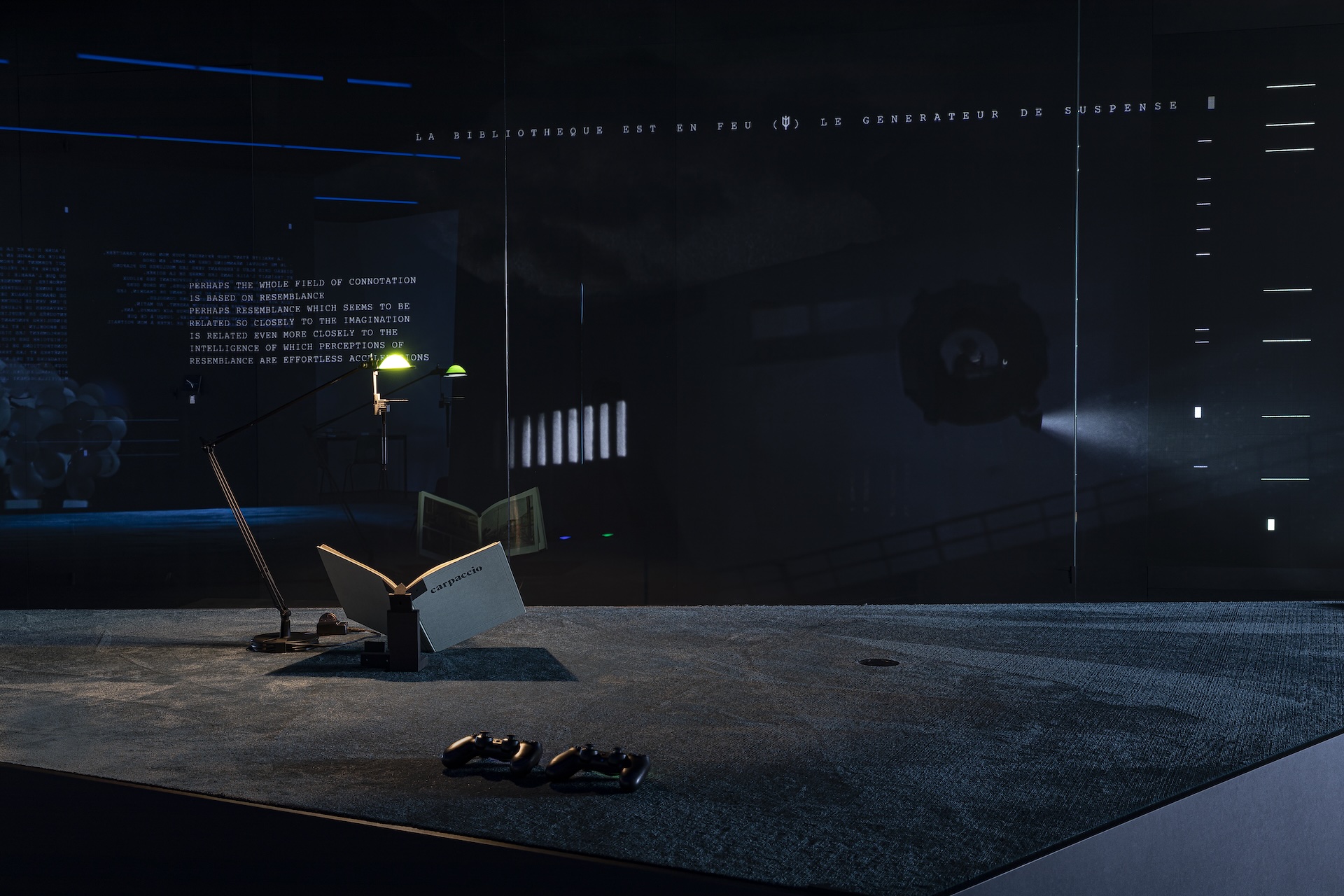
Acksetron Kusanagi is a software built on TouchDesigner developed to support vision of Charles Arsène-Henry and his long-term project, The Library is on Fire. In Acksetron Kusanagi, text, video, sound, and physical objects merge into interactive metafictions.
Background: The Library is on Fire
The Library is on Fire is a practice exploring superimposition and juxtaposition of texts, images, and objects. Since its inception in 2011, the Library has taken nomadic forms in Arles, Istanbul, London, and occupies the third floor of the Luma Tower since 2021. Within this space, visitors can engage with “Diaphors” which are projected multimedia compositions. The Library is on Fire operates as a living archive and reading instrument.
Why Acksetron Kusanagi
Early workflows for Diaphor creation relied on manual video compositing, screen recordings, and off-the-shelf software, which were time-consuming and limited accessibility. Acksetron Kusanagi was developed to:
- Enable real-time rendering of text, video, and sound superimpositions.
- Make the creation of Diaphors as immediate and intuitive as writing a poem.
- Provide tools for visitors and collaborators to interact with and manipulate the compositions in real-time.
Features
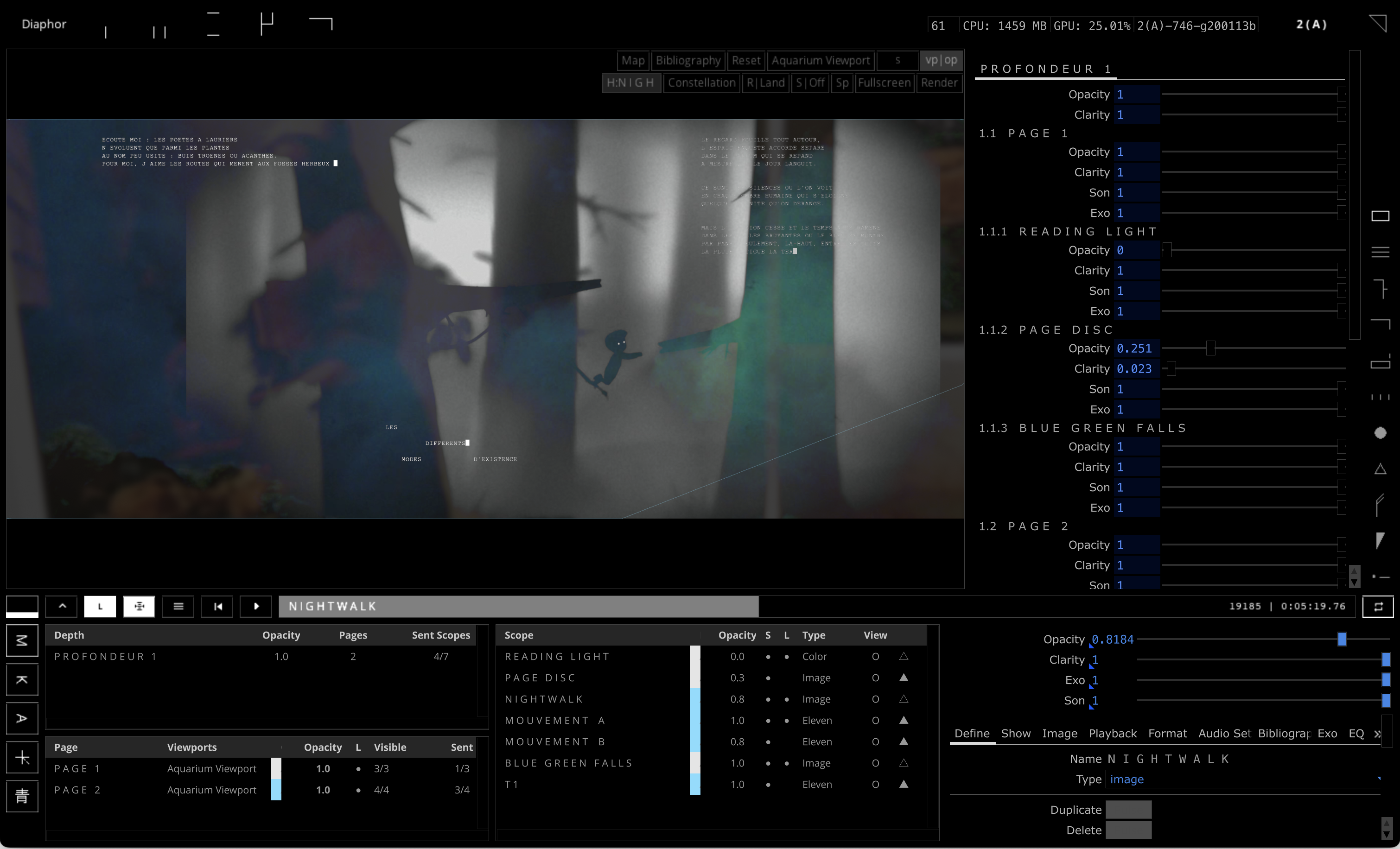
- The media items are called Scopes, and they can be text, video, live inputs, and colors.
- Text scopes can capture typing pace and cursor movement, or play back whole novels, with programmable breaks and pacing.
- Curve automation for parameters like volume, blur, and opacity.
- Mapping of audio and lighting to zones in the Library.
- Interaction with Diaphors is enabled by using DualShock controllers.
System Integration
- Plays back on multiple computers and projection setups, including LED screens and pixel-controlled ceiling luminaires.
- Uses NDI for flexible routing of video signals.
- Interfaces with Akira, the control desk, for tactile control with motorized faders.
Development
Development began in 2019 and the process meant translating a decade’s worth of metaphors into a real-time, interactive software system. The user interface was designed to correspond closely with the Library’s spatial architecture.